Ophthalmology instruments
Bone punch

Description
The Bonepunch is used to enlarge bony openings during OCR (ocular cataract removal). It consists of a stout spring handle and two blades at a right angle. Care must be taken to avoid damage to the nasal mucosa and septum during the procedure.
Uses
- Enlarges bony openings during OCR (ocular cataract removal).
- Care needed to avoid damage to nasal mucosa and septum.
Lacrimal Probes (Bowman’s)

Description
Lacrimal Probes are straight metal wires with blunt rounded ends, used to probe the nasolacrimal duct in cases of congenital blockage. They also help identify the lacrimal sac during DCT and DCR surgeries.
Uses
- Probes nasolacrimal duct in cases of congenital blockage.
- Identifies lacrimal sac during DCT and DCR surgeries.
Chalazion Scoop

Description
The Chalazion Scoop is a small cup with sharp margins, attached to a narrow handle. It is used to scoop out the contents of a chalazion during incision and curettage.
Uses
- Scoops out the contents of chalazion during incision and curettage.
Sinskey Hook (IOL Dialer)
Description
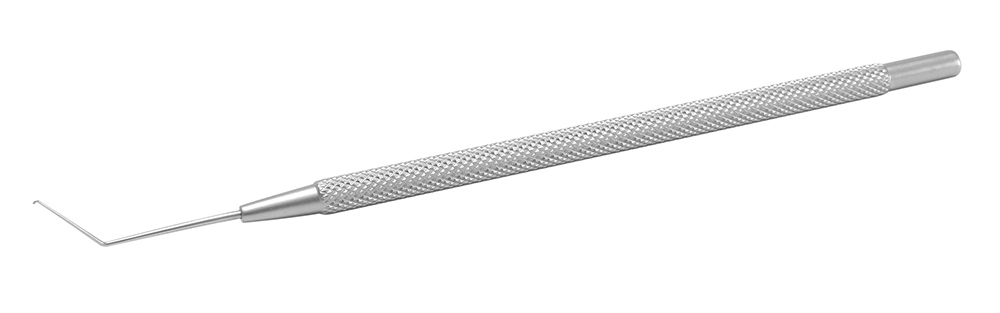
The Sinskey Hook is a fine, yet sturdy instrument used for positioning non-foldable IOLs in the capsular bag or ciliary sulcus during cataract surgery. It can also manipulate the nucleus in phacoemulsification surgeries.
Uses
- Positions non-foldable IOLs in the capsular bag or ciliary sulcus.
- Manipulates the nucleus during phacoemulsification.
Kelman-McPherson Forceps

Description
These fine forceps are primarily used to hold the superior haptic of IOL during placement. They can also tear the anterior capsular flap during ECCE and assist in suture tying.
Uses
- Holds IOL haptic during placement.
- Tears anterior capsular flap in ECCE.
- Can be used for suture tying.
Iris Repositor

Description
The Iris Repositor is a delicate, flat, malleable instrument with a blunt tip used to reposition the iris in the anterior chamber during intraocular surgery.
Uses
- Repositions iris in the anterior chamber.
- Breaks synechiae during surgery.
Two-Way Irrigation and Aspiration Cannula
Description
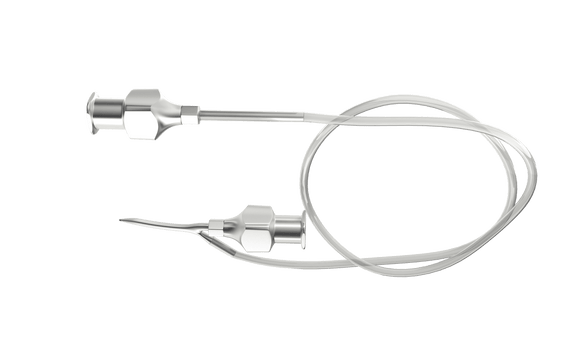
This cannula is used in cataract surgery for both irrigation and aspiration of the lens matter. It can also aspirate hyphaema.
Uses
- Used for irrigation and aspiration during cataract surgery.
- Aspirates hyphaema.
Chalazion Clamp

Description
The Chalazion Clamp is used to fix the chalazion and achieve hemostasis during incision and curettage. It has a disc on one limb and a small circular ring on the other for proper fixation.
Uses
- Fixes chalazion and achieves hemostasis during incision and curettage.
Globe Fixation Forceps
.png)
Description
These forceps are used to fix the eyeball during surgeries and during forced-duction tests to stabilize the eye.
Uses
- Fixes the eyeball during surgery and holds the eye during tests.
Superior Rectus Holding Forceps

Description
These forceps are used to hold the superior rectus muscle during bridle suture placement and stabilize the eyeball during surgery.
Uses
- Holds the superior rectus muscle during bridle suture placement.
- Stabilizes the eyeball during surgery.
15° Side Port Entry Blade

Description
This fine straight knife is used to make a small, valvular corneal incision, commonly referred to as a side port incision, during phacoemulsification and other intraocular surgeries.
Uses
- Creates small valvular corneal incisions in phacoemulsification and other intraocular surgeries.
Corneal Scissors / Section Enlarging Scissors

Description
These are fine curved scissors with blades kept apart by spring action. They are available in various shapes and sizes. The universal corneal scissors can be used for both sides, while right and left curved corneal scissors are separated for use on respective sides.
Uses
- To enlarge corneal or corneoscleral incision in intracapsular and extracapsular cataract extraction techniques (rarely performed nowadays).
- To enlarge corneal incision in keratoplasty operations.
- To cut scleral and trabecular tissue in trabeculectomy.
- For cutting and undermining conjunctiva in various operations.
Crescent Knife

Description
The crescent knife is a blunt-lipped, bevel-up ophthalmic knife with cut-splitting action at the tip and both sides. Its blade is curved and may be mounted on a disposable plastic handle or fixed with a metallic handle.
Uses
- To make tunnel incisions in the sclera and cornea for phacoemulsification, manual small incision cataract surgery (SICS), and sutureless trabeculectomy.
- To separate the conjunctiva and subconjunctival tissue from the sclera and limbus in trabeculectomy.
- To separate partial thickness lamellae of sclera during trabeculectomy.
- To separate the pterygium head or limbal dermoid from the underlying corneal lamellae.
- To separate corneal lamellae in lamellar keratoplasty.
Cat's Paw Lacrimal Wound Retractor

Description
The Cat's Paw Lacrimal Wound Retractor is a fork-like surgical instrument with terminals bent inward, designed to provide effective retraction during delicate lacrimal and lid procedures.
Uses
- Used to retract the skin during lacrimal sac surgery.
- Assists in retraction during lid surgeries.
Spring Action Needle Holder

Description
Spring action needle holders are available in various sizes with straight or curved tips, in different shapes, and may be with or without a locking system. The jaws are finely serrated to hold fine needles firmly.
Uses
- For passing sutures in the conjunctiva.
- For suturing the cornea.
- For suturing the sclera.
- For suturing extraocular muscles.
Freer's Periosteum Elevator

Description
Freer's periosteum elevator is a double-ended instrument with a rounded handle and two slightly curved, tear-drop tips. It is primarily designed for blunt dissection, debulking, and lifting of the periosteum from bones in confined spaces.
Uses
- To bluntly debulk and lift the periosteum from bone surfaces.
- Used in endoscopic septoplasty for precise tissue dissection.
- Employed in dacryocystorhinostomy (DCR) procedures.
- Useful in surgeries involving dissection of soft tissue, cartilage, or bone.
Globe Fixation Forceps

Description
The globe fixation forceps have 2 × 3 or 3 × 4 teeth at the tip. They are applied near the limbus to hold the conjunctiva and episcleral tissue together, providing a firm grip on the eyeball.
Uses
- To fix the eyeball during intraocular and extraocular surgeries.
- To hold the eyeball while performing the forced-duction test.
Plain Forceps

Description
Plain forceps are simple, toothless forceps with serrations (either horizontal or vertical) near the tip. They are designed for holding delicate tissues without causing significant trauma.
Uses
- To hold the conjunctiva during surgical procedures.
- To assist in tying sutures.
- To hold the scleral flap in trabeculectomy.
- To hold skin during eyelid surgery.
- To hold nasal mucosal flaps and lacrimal sac flaps in dacryocystorhinostomy (DCR).
Corneo-Scleral Forceps

Description
Corneo-scleral forceps are available in many shapes and designs. Commonly used types include Calibri forceps and Lim's forceps. These forceps have very fine teeth (1 × 2) at the tip, making them suitable for delicate ocular tissue handling.
Uses
- To hold the corneal edge during suturing.
- To hold the scleral edge of incision during cataract surgery.
- To assist in suturing during glaucoma surgery.
- To repair corneal and/or scleral tears.
- To hold tissues during keratoplasty operations.
💬 Comments
No comments:
Post a Comment